
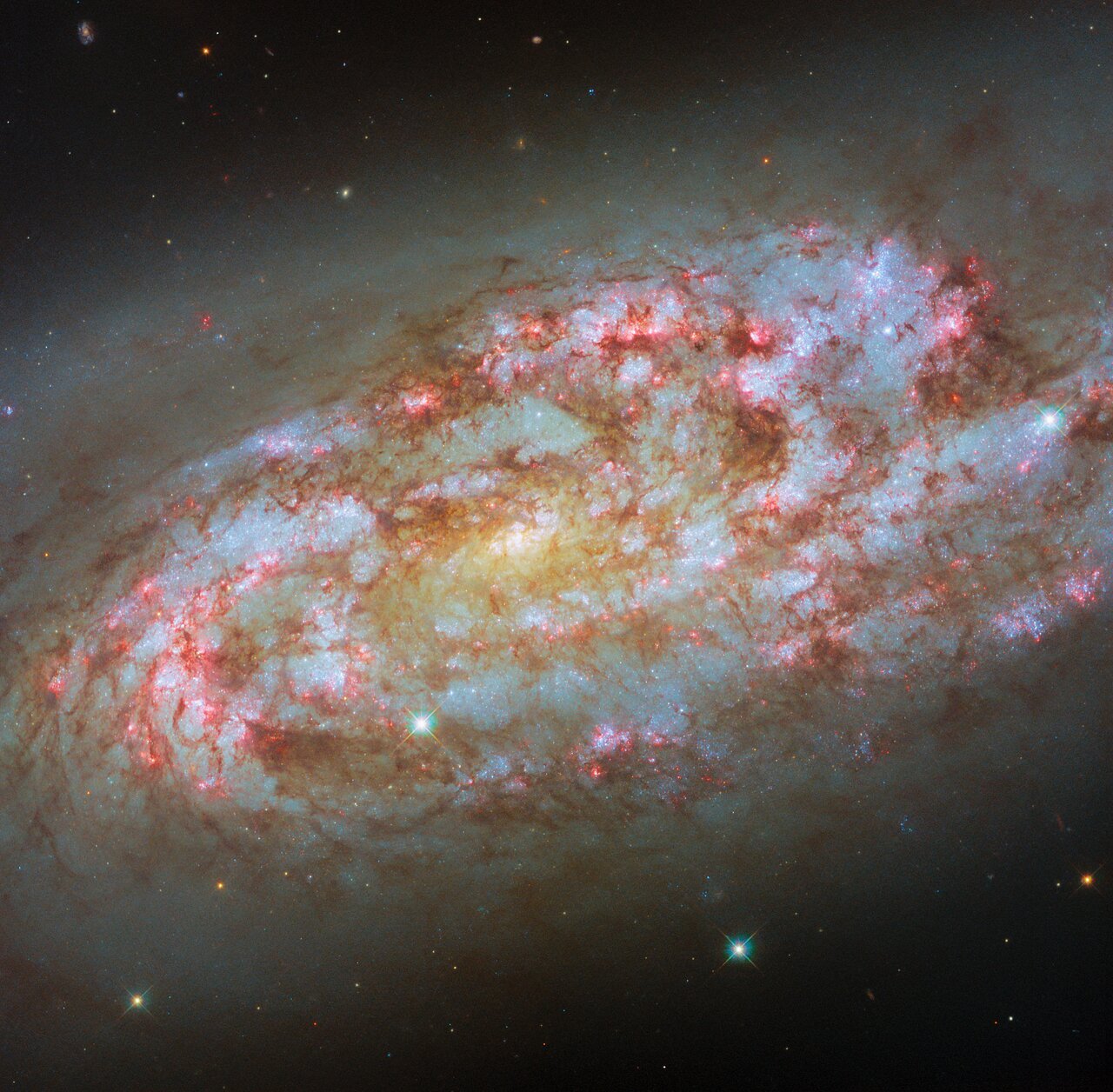
CIUDAD DE MÉXICO, 01 de diciembre de 2025 – El Telescopio Espacial Hubble, un proyecto conjunto de la NASA y la Agencia Espacial Europea (ESA), ha difundido una imagen actualizada de la galaxia espiral NGC 1792. Este objeto cósmico, ubicado a más de 50 millones de años luz de la Tierra en la constelación de Columba, es un foco de estudio clasificado como una galaxia con brotes de formación estelar (starburst).
Nuestra investigación se centró en los datos de la última observación, que incluyen información adicional recopilada en 2025, para comprender por qué NGC 1792 es un centro neurálgico de creación estelar.
La Dinámica Galáctica que Desencadena Estrellas
La actividad frenética de formación de estrellas, que produce una luminosidad inusual para su masa, se atribuye a la compleja interacción gravitacional con su vecina de mayor tamaño, la galaxia NGC 1808. Los astrónomos señalan que este “tirón” ha agitado las reservas de gas de NGC 1792, creando una presión selectiva que concentra la creación estelar. Reportes científicos indican que la interacción de marea en este grupo galáctico es la causa principal de su estado starburst.
Para analizar esta actividad, los astrónomos del Hubble emplean filtros de banda estrecha calibrados para longitudes de onda específicas:
- Luz Roja (H-alfa): Las prominentes manchas rojizas en los brazos espirales son indicativas de la emisión H-alfa. Este es el rastro del gas de hidrógeno ionizado (regiones H II) que emite luz a una longitud de onda muy específica, un signo inequívoco del nacimiento de estrellas jóvenes y masivas.
- Luz Azul: El brillo azulado en los brazos es producido por la presencia de cúmulos de estrellas jóvenes y calientes, cuya vida es breve pero extremadamente luminosa.
NGC 1792 sirve como un caso de estudio crucial para la astrofísica, pues ayuda a modelar cómo las fuerzas externas entre galaxias impulsan y, eventualmente, detienen estos feroces brotes de formación estelar.
Fuentes
- https://esahubble.org/images/potw2548/
- https://science.nasa.gov/missions/hubble/hubble-sees-a-stellar-furnace/
- https://www.eso.org/public/spain/videos/eso0938a/
- https://science.nasa.gov/missions/hubble/hubble-filters-a-barred-spiral/
- https://es.wikipedia.org/wiki/Galaxia_con_brote_estelar
holamorelia